Materials
Lighter Rubber Boots: Start with the Weight of the Whole Boot
A lower-density compound is only part of a lighter boot. Here is how to separate material changes from construction changes before approving a sample.
Read the storyPut two boots on a scale and the lighter one seems like the obvious winner. That comparison becomes less useful if one has a shorter shaft, a thinner lining or a smaller size label.
For a buyer developing lightweight rubber boots, the first useful number is the weight of a complete boot in an agreed reference size. Record whether that number includes the footbed, lining and accessories. Keep the same configuration when comparing revisions. Otherwise, it is easy to credit the compound for weight that disappeared somewhere else.
Separate density from the amount of material
For a component with a fixed volume, weight follows density. Suppose a sole occupies 200 cm³. At 1.20 g/cm³ it weighs 240 g; at 1.00 g/cm³ it weighs 200 g. That is a 40 g saving per sole, not a 16.7% reduction in the weight of the complete boot. These are illustrative numbers, not measurements from our catalog.
The second route is to use less material. This deserves a drawing review, not just a request for thinner rubber everywhere. SATRA notes that excess sole thickness adds weight and can reduce flexibility, while an overly thin sole can lose durability and ground insulation. The decision belongs at the component level: which area can change, and which area needs to stay as it is?
For a tall hunting boot, ask for separate weights for the bottom unit and the rest of the boot where practical. That gives the development discussion somewhere concrete to start.
Where foaming fits
Cellular materials are one route to lower density. Nouryon describes expandable microspheres as lightweight fillers and blowing agents, and lists shoe soles among their applications. That establishes a development option; it does not establish that a particular grade will work in an existing rubber boot process.
Before selecting an additive, ask the compound developer to check its processing window against the proposed mixing and curing conditions. Agree which component is being changed. A cushioning layer, a ground-contact outsole and a boot upper do different jobs, so one target density is not a specification for all three.
A useful sample brief might read: keep the reference size, shaft height and lining unchanged; propose a weight reduction for the bottom unit; return both the component weight and finished-boot weight. This is more informative than asking for the lightest possible compound.
Decide what must stay the same
Write down the properties that cannot be traded away before comparing the samples. Depending on the application, these may include abrasion, flexing, water resistance, grip or the way a cushioning component recovers after compression. Have the laboratory choose suitable methods and conditions for the actual construction.
Keep the original sample alongside each revision. If a change feels promising, record exactly what changed and test that version before making another adjustment. A lighter sample is worth developing further when the weight saving is traceable and the rest of the agreed requirements still hold.
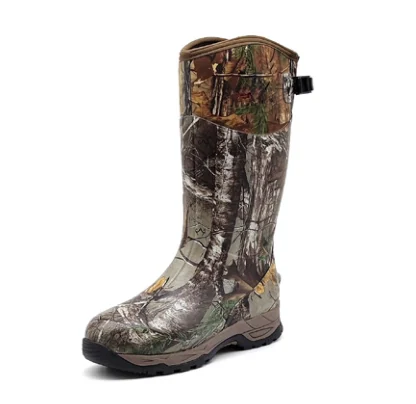
You can use our hunting boot collection to choose a starting silhouette. Send the model code, reference size, current sample weight and target application with your inquiry. The photographs identify catalog styles; they do not demonstrate a particular lightweight formulation.
Technical reading
Dongshi Huateng · Rubber footwear & waders
Discuss your next collection ↗